
Data centers
Building the electrical infrastructure of the digital economy
France is going through an unprecedented wave of data center construction, driven by the cloud and artificial intelligence. Behind every project lies a challenge that is above all electrical: connecting the site to the grid, distributing power that never stops, and proving through testing that everything works before handover. This is where our engineers work.
The data center landscape in France
Ademe, the French environment agency, counts 352 data centers in operation in France, mostly in the Paris region. But it is the new generation that changes the scale: campuses dedicated to artificial intelligence, from several hundred megawatts to more than a gigawatt.
In Seine-et-Marne, the Fouju AI campus targets up to 1.4 GW. In Hauts-de-France, SoftBank has announced a first phase of €45 billion for 3.1 GW across three sites by 2031, and Data4 a €5 billion campus in Escaudain. In total, RTE, the French transmission system operator, had reserved nearly 18 GW of grid connection capacity for around 80 projects in May 2026, up from 5 GW at the end of 2024.
To find out more about these projects, read our article Data centers in France: a map of the major projects.
The first challenge: power
In a data center, everything starts with electricity.
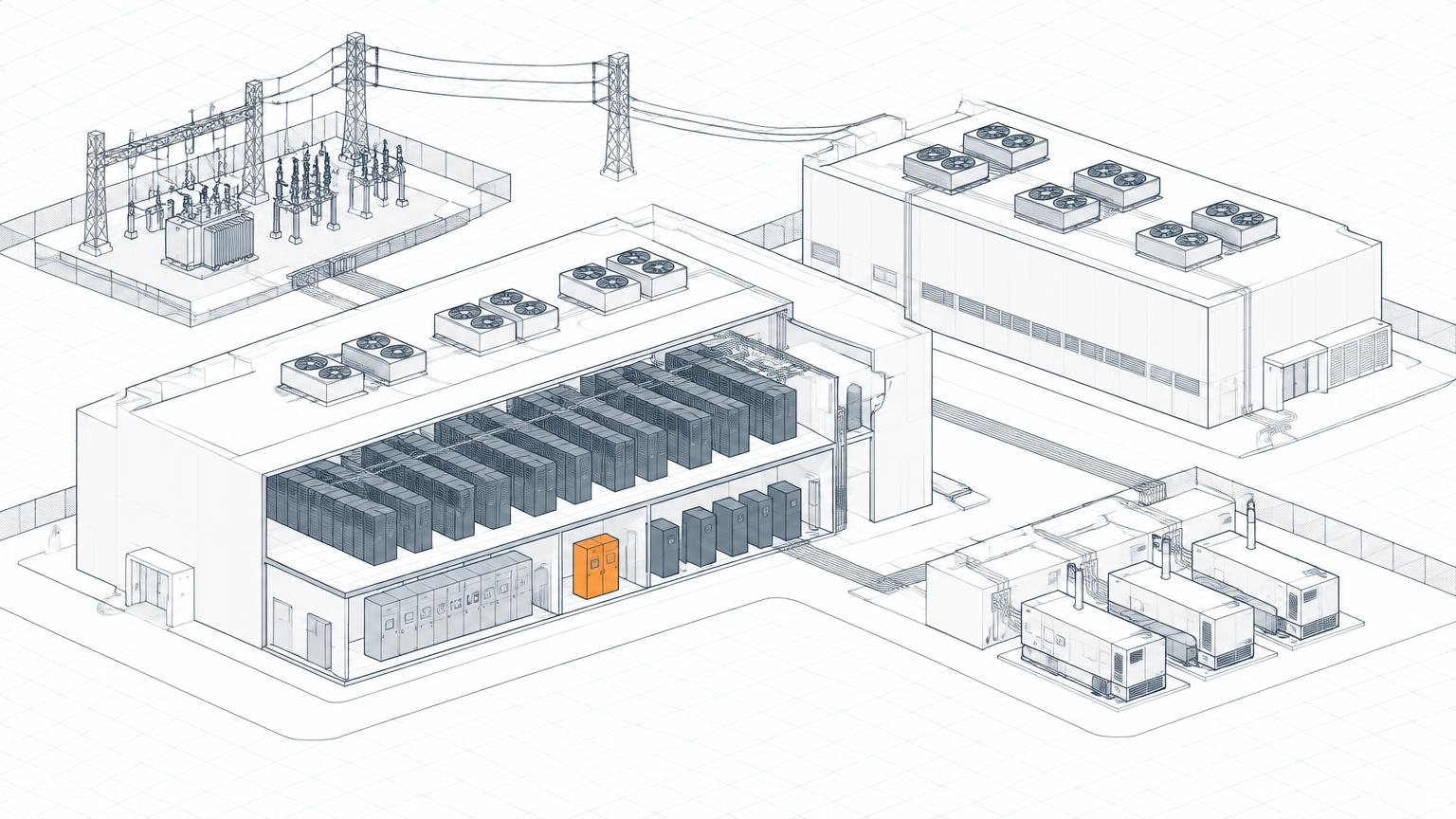
Grid connection. A large campus must be connected to the extra-high-voltage grid, with its own substation. This is often the longest step in a project, so much so that RTE has created a fast-track connection procedure for five very large sites.
Distribution. Inside, power flows through transformers, switchboards, UPS systems and batteries before reaching the server racks. Every component is duplicated so that a single failure never interrupts the service.
Backup. If the grid fails, generators take over within seconds, while the batteries keep the load running.
Density. With AI, the power drawn by a server rack has risen sharply. Electrical installations and cooling have to keep up.
The moment of truth: commissioning
A data center is only handed over once it has been proven to deliver on its availability promises. That is the role of commissioning, a step-by-step start-up in several levels:
Factory acceptance tests
equipment (switchboards, UPS, generators) is tested at the manufacturer's premises before delivery.
Site acceptance
equipment is checked on arrival and once installed.
Pre-functional checks and energisation
each piece of equipment is started and checked individually.
Functional tests
each system is tested in all of its operating modes.
Integrated systems tests
the whole site is tested in real conditions, with simulated outages and failures.
These tests follow detailed, approved and traceable procedures. A mistake at this stage can delay handover by several weeks or, worse, only come to light once the servers are live.
What we do there
Our electrical engineers, project managers and commissioning engineers provide technical assistance on data center projects. We work from the bid analysis through to handover of the site to the client.
Wellington's career is a good example.
For a major data center operator in the Île-de-France region, Wellington first worked as site electrical engineer. He coordinated factory acceptance tests with manufacturers, checked key installations (distribution, cabling, earthing), supervised the field teams and led the testing and validation of the electrical systems, acting as the link between the design office, subcontractors and the client.
Since October 2025 he has been a project manager: he runs complete projects, from bid and budget analysis through to handover to the client, coordinates engineering, works and commissioning, and approves commissioning procedures and reports.
Jan.–Oct. 2025
Site electrical engineer
Since Oct. 2025
Data center project manager